
4.3 Social: fundamental human rights, impact & equity
4.3.3 Key points of the social and human resources (HR) policyWorkforce and skills planning
The Talent and HR teams in the countries are responsible for building short- and medium-term forecasts. The communication and digital transformation sector is structurally a very dynamic job market, where experience is acquired through a variety of projects, clients and sectors. Employees change agencies or companies regularly, customary in this sector. Given this structural mobility, the challenge for Publicis Groupe’s HR/Talents teams is to carry out distinctive recruitment actions in parallel to attract the best talent and to use retention levers in order to offer employees a comprehensive and enriching career path within the Groupe. All functions are subject to forward planning, with particular attention paid to data and tech professions, which are in high demand across all industries and for which the Groupe has real advantages in terms of freedom to innovate and cross-functional skills.
The Groupe’s tools for this planning are based on Career Settings, the HRIS (Human Resources Information System), which allows fairly detailed demographic analyses by business line, level of experience and level of responsibility, and Career Conversations, centered on monitoring employees’ performance and perception of their operational roles and functions. Since 2022, with the Marcel platform and thanks to these tools, the personalization of career paths has improved in recent years based on objective data. The contribution of external partners on local changes in the labor market is also used, whether in terms of training courses, guests for inspiring sessions or dialogue on local issues. Finally, relations with academic institutions (schools, colleges and universities) and training organizations enable cooperation on current or future changes to training courses for future professionals.
4.3.3 Key points of the social and human resources policy
Human capital has been a key asset of Publicis Groupe since its founding in 1926.
Issues around talent and those related to the professional development of employees are managed by the Groupe’s Chief Talent Officer, a member of the Management Committee, who relies on the HR and Talent teams in the countries and agencies for the deployment of Groupe programs. HR matters are managed by the Groupe HR Operations Department, which reports to the Groupe Secretary General, a member of the Management Committee. This Department works with the HR and Talent teams in the countries, as well as with the Re:Sources teams. The CTOs Council meets every month to prepare and monitor numerous Groupe initiatives. Issues related to Impact & Social Equity, in association with the Talent and HR teams, are monitored by the Chief Impact Officer, a member of the Management Committee, and with the support of the Groupe Impact & Equity Council, bringing together around 20 local Managers every two months. [S1-4-39]
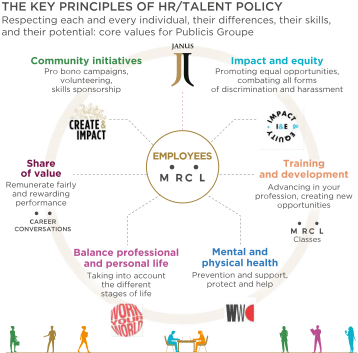
This circular diagram presents the six pillars of Publicis Groupe's employee policy, organized around the central M R C L program.
Societal Initiatives: pro bono campaigns, volunteering, skills-based sponsorship.
Associated program: Create & Impact.
Impact & Equity: promoting equal opportunities, combating all forms of discrimination and harassment.
Associated program: Impact I&E Equity.
Training & Development: advancing professional skills, creating new opportunities.
Associated program: M R C L Classes.
Mental & Physical Health: preventing and supporting, protecting and assisting.
Associated program: WWC.
Work-Life Balance: taking into account the different stages of life.
Associated program: Work Your World.
Value Sharing: fair compensation and performance recognition. Associated program: Career Conversations.
The Janus program is referenced in the header of the diagram.
The Groupe’s HR General Policies & Rules is the Groupe-wide reference framework and includes the key points behind which countries must align. It incorporates the ten principles of the United Nations Global Compact, including articles 1 to 6 on human rights and labor rights. Countries have defined their additional social policies in order to be more precise in their implementation, to take into account legal particularities, and to innovate locally to meet the expectations of employees.