
Analysis of the 2025 trajectory: the reduction trajectory is not linear for two reasons: the beneficial effects of the actions implemented by the Company may have effects that are manifested in the medium term and not in the short term, and the economic growth of the Groupe automatically increases several types of impacts such as purchases and business travel. The slight reduction is due to several factors: the consolidation of office space, the better qualification of purchases in certain categories and the use for the first time of emission factors from several IT suppliers (see Scope 3 explanations - Upstream - 1st point), and lastly, the growing share of renewable energy from direct sources.
However, the data for 2025, i.e. at the halfway point, show GHG emissions in absolute value terms close to 2019, making the initial objective of reducing Scope 3 by 50% by 2030 difficult to achieve. This is why in 2026, taking into account the Company’s strong growth, the Groupe will submit new objectives to the SBTi. [E1-4-34 (c)]
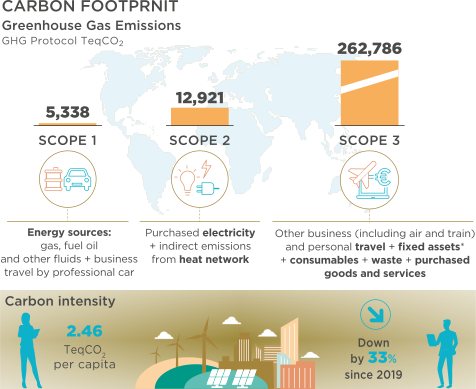
This infographic presents the carbon footprint of Publicis Groupe, expressed in GHG Protocol tCO2e.
Scope 1: 5,338 tCO2e. Energy sources: gas, fuel oil and other fluids, and business travel by car.
Scope 2: 12,921 tCO2e. Purchased electricity and indirect emissions related to the district heating network.
Scope 3: 262,786 tCO2e. Other business travel (including air and rail) and commuting, fixed assets (*), consumables, waste and purchases of goods and services.
Carbon intensity: 2.46 tCO2e per capita, down 33% since 2019.
Scopes 1 and 2
With regard to Publicis Groupe’s intellectual services activities, the impact mainly comes from:
-
business travel by car, estimated at 34,133 thousand km, for associated emissions of 309 TeqCO2.
For company vehicles or service cars, for the past 15 years, the Groupe has aligned its professional vehicles policy (Car Policy) on the European targets of 95g CO2 maximum, and supports the target of zero-emission road mobility by 2035 indicated in the European draft regulation Fit-for-55. Individual practices have evolved in favor of hybrid andelectric vehicles;
-
energy consumed is estimated at 111,310 MWh for associated emissions of 11,312 TeqCO2 [E1-4-32, E1-4-34, E1-5-36]
Renewable energy (RE) from direct sources, via suppliers, accounts for 79.7% of total consumption (based on the certifications given by electricity suppliers). In some countries, the energy mix (renewables versus non-renewables) has made little progress or is even fluctuating. The 100% renewable energy plan for 2030 is reinforced by long-term contracts, to take into account unexpected volatility in renewable energy; it is based on several points:
- reducing energy consumption, regardless of the source, everywhere;
- the switch to 100% renewable energy supply contracts is continuing through discussions with the managers of the buildings where our offices are located, where feasible;
- the use of "High impact RECs" (Renewable Energy Certificates) to achieve the objective of 100% by 2030 in the various countries, in structurally blocked situations, where the Groupe cannot choose its energy supplier or energy mix, such as:
- when it is a government- or city- regulated market which does not allow choice ofelectricity supplier,
- when the building operator is blocked by its contract with a supplier that does notoffer renewable energy,
- when we are faced with a refusal by the other tenants to switch to renewable energy because of a price difference.