
4.2 Environment: fight against climate change
4.2.2 Reducing impacts with the Net Zero Climate Policy4.2.2 Reducing impacts with the Net Zero Climate Policy(1)
In 2019, Publicis Groupe achieved its initial Climate targets for 2020 and 2030. In 2020, Publicis Groupe launched a new cycle of actions by increasing its ambitions and voluntarily committing to an approach verified by the SBTi (Science Based Targets initiative) for 2030 and 2040. The trajectory adopted is that of the Paris Agreement and a 1.5°C scenario. Under the ESRS, this policy covers:
- climate change mitigation;
- climate change adaptation;
- energy efficiency;
- deployment of renewable energy;
- other areas.
[E1-2-25 (a) to (e), E1-3-28]
This environmental policy relies on an EMS (Environmental Management System) which has been in place for the past several years to organize projects. It is based on the voluntary ISO 14001 standard, with precise targets, annual reporting with quantitative and qualitative data (via HFM CSRGRI, P.A.R.I.S., etc.) and proprietary tools (A.L.I.C.E., P.A.S.S., etc.) designed to constantly improve the measures in place and innovate both in terms of business lines and suppliers. This EMS applies to all subsidiaries; it is managed by the Groupe’s CSR Department under the supervision of the Chief Impact Officer, who is a member of the Management Committee, and is reviewed annually to seek continuous improvements.
27 subsidiaries representing 16.6% of employees are IS0 14001 certified; these are the entities for which this certification is essential to work with certain clients.
An intermediate stage is planned with carbon neutrality for the entire Groupe before 2030 (neutrality meaning GHG emissions are offset by voluntary carbon credits). To offset irreducible impacts, VCCs (Voluntary Carbon Credits) are used only as a last resort. This annual operation is managed centrally by the Groupe and only covers Scopes 1 and 2 emissions, as well as air transportation (Business travel) in Scope 3. [ESRS 2 MDR-T-80 (a) to (j)]
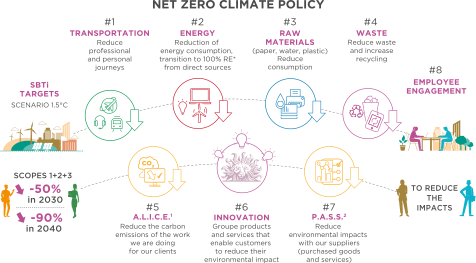
This diagram presents the Net Zero Climate Policy of Publicis Groupe, structured around 8 action levers aimed at achieving SBTi targets in line with the 1.5°C scenario.
Global targets (Scopes 1+2+3).
- 50% by 2030.
- 90% by 2040.
The 8 action levers are as follows.
- Lever 1 — Travel: reduction of business and personal travel.
- Lever 2 — Energy: reduction of energy consumption and transition to 100% renewable energy from direct sources.
- Lever 3 — Raw Materials: reduction of paper, water and plastic consumption.
- Lever 4 — Waste: reduction of waste and increase in recycling.
- Lever 5 — A.L.I.C.E. (*): reduction of carbon emissions related to work carried out for clients.
- Lever 6 — Innovation: Group products and services enabling clients to reduce their environmental impacts.
- Lever 7 — P.A.S.S. (**): reduction of environmental impacts with suppliers (purchased services and goods).
- Lever 8 — Employee Engagement: internal mobilization to reduce impacts.
The policy incorporates the elements of the Transition plan and is structured around the following eight levers: [ESRS 2 MDR-T 78 & 79, E1-2-24, E1-2-25, E1-4-34]
- reduction of transportation, particularly by air, and its impacts, thanks to the reduction in air business travel and the use of teleconferencing tools.
- reduction in energy consumption and switch to 100% direct-source renewable energy. Improving the energy efficiency of offices and buildings, seeking to limit the impacts of electricity, heating and air conditioning, remains key.
- reduction in consumption of natural resources and raw materials (mainly paper, water, plastics). The global plan launched at the beginning of 2020 to eliminate single-use plastics (Zero Single-Use Plastic) from all agencies in order to rapidly comply with the ambitious objectives of the plan voted by the European Parliament remains in place;
- reduction in waste volume: the systematic use of recycling channels, particularly for electronics and IT products (Waste from Electrical and Electronic Equipment or WEEE), and the organized management of non-hazardous waste remain the priorities;
- reduction of the impacts of campaigns and projects completed for clients: the Groupe has created an internal impact assessment platform called A.L.I.C.E. (Advertising Limiting Impacts & Carbon Emissions), which makes it possible to measure and find less impactful options (Section 4.3.12.2);
- product and service innovation at agency and country level, with new solutions offered to clients to support their energy and environmental transition. (Section 4.2.1.4);
- reduction of the impacts related to purchased goods and services. The CSR for Business Guidelines are an integral part of the contracts signed with suppliers. Strategic suppliers are required to be assessed by an independent third party in terms of CSR (EcoVadis or others). For other suppliers, a self-assessment platform for their CSR approach is available: P.A.S.S. (Publicis Groupe Providers’ Platform for a self-assessment for a Sustainable Supply chain) (Section 4.4.4.4). [E1-1-14, E1-1-16 (a) & (b), E1-3-28, E1-3-AR 19 (d)]
- mobilization of teams: everyone must act both in their daily lives and in the services provided to clients, and through environmentally and socially responsible implementation of projects. Team training is central.