
THRESHOLD FOR MATERIAL IROs
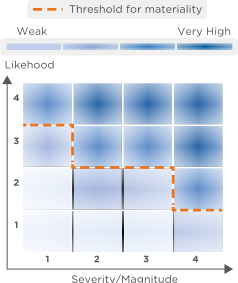
This diagram presents the materiality threshold applied to material Impacts, Risks and Opportunities (IROs), in the form of a 4x4 matrix crossing two axes.
Vertical axis: Likelihood, from 1 (low) to 4 (very high).
Horizontal axis: Severity/Magnitude, from 1 (low) to 4 (very high).
The materiality threshold is represented by an orange dotted line. Combinations of cells above and to the right of this threshold correspond to IROs considered material. Combinations below and to the left correspond to non-material IROs.
Material combinations are as follows.
- Likelihood 4 : Severity 2, 3 and 4.
- Likelihood 3 : Severity 2, 3 and 4.
- Likelihood 2 : Severity 3 and 4.
- Likelihood 1 : Severity 4.
Non-material combinations are as follows.
- Likelihood 4 : Severity 1.
- Likelihood 3 : Severity 1.
- Likelihood 2 : Severity 1 and 2.
- Likelihood 1 : Severity 1, 2 and 3.
On this basis, and in light of the 143 IROs analyzed, the decision was made to retain in the DMA material issues with a high level of severity and a certain probability (see diagram). These topics structure material sustainability issues for the company. The scales used for the double materiality analysis are based on those used in the Groupe’s risk mapping, in order to maintain overall consistency (see Chapter 2).
The double materiality analysis gives a prominent place to social issues; this is consistent for an intellectual services company like Publicis, whose major asset is its employees. Topics of business ethics and responsible marketing around the societal role that communications and technology can play in the coming ecological and social transitions are also among the topics considered important by clients and employees alike. While there are regional differences, they do not call into question the order of priorities.
This work did not highlight any obvious dependencies, whether in terms of impacts, risks or opportunities. [ESRS 2 SBM-3-48 (a) to (c)]
ANALYSIS METHOD FOR ASSESSING DOUBLE MATERIALITY
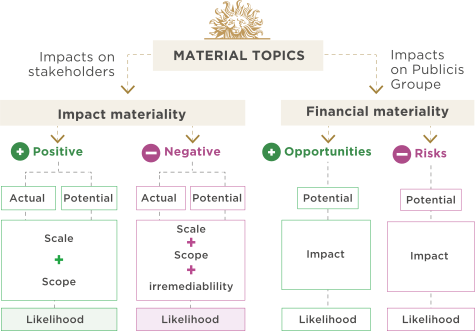
This diagram presents the analysis method for evaluating double materiality, organized around material topics and broken down into two dimensions.
Impact materiality: assesses impacts on Stakeholders.
- Positive impact (actual and potential): evaluated according to scope, perimeter and likelihood.
- Negative impact (actual and potential): evaluated according to scope, perimeter, irremediability and likelihood.
Financial materiality: assesses impacts on Publicis Groupe.
- Opportunities (potential): evaluated according to impact and likelihood.
- Risks (potential): evaluated according to impact and likelihood.
To date, this analysis had not revealed any major immediate impact on the Groupe’s strategy and business model, activities, client portfolio or geographical locations. It did not identify any significant elements resulting from the double materiality analysis to be reported in the financial statements. Action plans are integrated into the efficient running of the Company and do not require any operational expenditure or significant investment. The methodologies used to set targets and metrics are indicated in each topical ESRS. [ESRS 2 SBM-3-48 (d) & (e), ESRS 2 MDR-A-69 (a), ESRS 2 MDR-M-77 (a), ESRS 2 MDR-T-80 (a) to (f)]
The double materiality – impact and financial – is presented in a summary table. They are detailed at the beginning of each ESRS. [ESRS 2 SBM-3-48 (a), ESRS 2 SBM-3-48 (c) i, ESRS 2 SBM-3-48 (c) iii]