
4.1 General information
4.1.3 CSR/ESG governance4.1.3 CSR/ESG governance
CSR GOVERNANCE
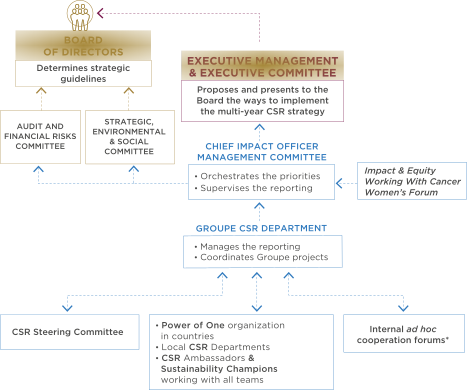
This diagram presents the CSR governance structure of Publicis Groupe.
Board of Directors (BoD): defines strategic orientations. It is supported by two committees: the Audit and Financial Risks Committee, and the Strategic, Environmental & Social Committee.
General Management & Executive Committee: proposes and presents to the BoD the implementation modalities of the multi-year CSR strategy.
Chief Impact Officer — Management Committee: orchestrates priorities and oversees Reporting. It is informed by three external bodies: Impact & Equity, Working With Cancer, and Women's Forum.
Group CSR Department: leads Reporting and coordinates Group-wide projects. At the operational level, three entities report to the Group CSR Department.
- CSR Steering Committee.
- Power of One organization across countries, comprising local CSR Departments and CSR Ambassadors & Sustainability Champions working with all teams.
- Ad hoc internal cooperation bodies(*).
At Board level, CSR/sustainability governance is shared between the Audit and Financial Risks Committee, which monitors the application of the CSRD system, and the Strategic, Environmental and Social Committee, which monitors major actions.
Chapiter 3 of this Universal Registration Document presents in detail:
- the composition of the Board of Directors and Committees, including employee representation, the Board’s diversity policy, the independence of the Directors, their experience and skills; [ESRS 2 GOV-1-21 (a) to (e)] [ESRS 2 GOV-1-23 (a)&(b)]
- the duties and activities of the Board and its committees during the financial year; [ESRS 2 GOV-1-22 (a), (c) ii]
- the respective roles and responsibilities of the governance and executive managementbodies; [ESRS 2 GOV-1-22 (c)]
- their particular involvement in the analysis of impacts-risks-opportunities; [ESRS 2 GOV-1-22 (b)]
- the processes and procedures as well as the links between the various bodies, and thecontrol procedures in place. [ESRS 2 GOV- 1-22 (c) i, ii, iii & (d)]
- in 2024, the missions of the Audit and Financial Risks Committee of the Board (see Section 3.1.4.1 of this document) changed to integrate its new responsibilities on sustainability reporting, particularly its monitoring of impacts, risks and opportunities concerning sustainability. The Committee also ensures the integrity of the sustainability reporting process and the effectiveness of the internal control and risk management systems interms of sustainability reporting. The update of the climate risk mapping was presented. It did not highlight any new risks for the company. The results of the revised double materiality analysis were shared in order to explain the more granular approach, which helped to validate the revision of the impacts, risks and opportunities (IROs). Regulatory changes in sustainability reporting are presented, along with a parallel analysis of short- and medium-term actions. The committee was regularly informed of the progress made by the Chief Impact Officer, as well as the work carried out to prepare the sustainability report; [ESRS 2 GOV-1-22 (a) to (c)]; ESRS 2 GOV-2-26 (a) to (c); ESRS 2 IRO-1-53 (e)&(f)]
- in 2025, the Board’s Strategic, Environmental and Social Committee (see Section 3.1.4.4 of this document) was informed of the revised climate risk mapping and the updated double materiality analysis. The deployment of the N.I.B.I. (No Impact for Big Impact) program on responsible marketing and technology was presented. The annual monitoring of the implementation of the Duty of Care Plan makes it possible to see changes in actions and indicators; [ESRS 2 GOV-1-22 (a) to (c) i ; ESRS 2 GOV-2-26 (a) to (c)]
- within the Executive Committee, chaired by Mr. Arthur Sadoun, Chair and Chief Executive Officer, CSR issues are supervised by Mrs. Agathe Bousquet, Chair of Publicis Groupe in France, who deals with cross-functional issues across the three pillars of the Company (Intelligent Creativity, Connected Media, Technology), including CSR; [ESRS 2 GOV-1-22 (c) i, ii, iii]
- within the Management Committee, the Chief Impact Officer, Nannette Lafond Dufour, oversees the CSR strategy and sustainability reporting, as well as the Groupe’s flag ship initiatives, such as the Women’s Forum, Working With Cancer advocacy and social equity issues; [ESRS 2-MDR-P-65 (c)] [ESRS 2 GOV-1-22 (c) i,ii,iii]
- the Groupe CSR Department reports to the Chief Impact Officer. This team is in charge of developing and deploying the ESG strategy, projects and changes to the policies involved in the Groupe’s CSR strategy, and monitoring action plans and targets. This department is in charge of sustainability reporting. This department is a source of proposals to Executive Management for changes to be implemented in order to achieve the targets approved by the Groupe’s governance bodies. The Janus Code of Conduct and Ethics incorporates these elements into ESG policies. The CSR Department relies on the CSR Steering Committee, in place since 2015, which brings together the corporate departments: Legal and Compliance, Finance and Information Systems, HR Operations, Groupe Procurement, Risks, Internal Financial Control, Internal Audit, Shared Services/Re:Sources (IT, Real Estate, etc.). The managers of the countries or activities are involved in the work in order to take into account the CSR challenges of clients. The 2025 work mainly focused on the review of the double materiality analysis;
- the CSR Department leads several internal bodies that have been set up for sharing experience and cooperation, such as the Groupe Impact & Social Equity Council, which brings together the managers responsible for inclusion and Impact & Social Equity programs every two months, or the Climate Crew, which brings together the teams in charge of reducing climate impacts every two months. It is also working with various business lines to identify metrics specific to the challenges of responsible marketing. In 2025, it led the international extension of the N.I.B.I. (No Impact For Big Impact) internal program. [ESRS 2 GOV-1-22 (c) i,ii,iii]
- the Audit and Internal Financial Control (Financial Monitoring Controls) Department have included certain topics related to the sustainability report preparation, such as those relating to talent, personal data compliance issues, and IT system security;
- the Risk Management team collaborated on the update of the climate risk mapping, as well as the revision of the double materiality analysis, alongside the Finance Department;
- the Finance Department is involved in the various risk mapping work (climate risks, ESG risks, double materiality analysis). Working with this Department, the European Taxonomy and its qualification criteria are monitored. It is also in close cooperation that structuring projects are prepared and deployed (internal carbon price, emissions reduction-related investments, etc.);
- the Risk Management and FMC (Financial Monitoring Controls) teams (see Section 2.2) support the CSR Department in structuring an ESG control framework, which integrates the elements of the CSRD and ESRS;
- the Groupe HR Operations Department, responsible for Groupe HR policies, handle all social indicators at Groupe level, in partnership with the various teams responsible for the different tools. It has also participated in the double materiality revision work;
- in the agencies and countries, operational deployment of CSR actions is carried out under the responsibility of local management, and priority actions are implemented based on topic by their dedicated CSR teams (CSR Ambassadors or Sustainability Champions), the Talent, HR or Impact & Equity teams, and of course with the Operational Business teams. Not to mention the local Re:Sources teams for the support functions in the shared service centers, which collect environmental data. It is important to highlight the very large number of employees volunteering to start new CSR initiatives and innovate in their daily professional practices. [ESRS 2 GOV-1-22 (a)]